Being Held by God in the Time Between
On 17th May, the seventh Sunday of Easter - after Ascension Day, but before Pentecost Sunday - Lee Williams gave us this homily:
The First Reading Acts 1: 6-14
The Psalm Psalm 68:1-10, 33-36
The Second Reading 1 Peter 4:12-14; 5:6-11
The Gospel John 17:1-11
May the grace of our Lord Jesus Christ, and the love of God, and the fellowship of the Holy Spirit be with us all.
On this Seventh Sunday of Easter, we find ourselves in a curious and holy in-between place. Jesus has ascended, but Pentecost has not yet come. The disciples are no longer watching him with their eyes, but they have not yet received the full gift of the Spirit. They are between promise and fulfillment, between loss and hope, between standing on the hillside and being sent into the world. That is where much of Christian life happens too. We live between what God has promised and what we can already see. We live between prayer and answer, between suffering and healing, between fear and trust.
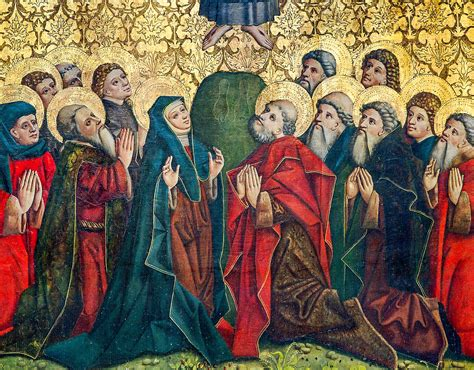
In Acts, the disciples ask Jesus a very human question: “Lord, is this the time when you will restore the kingdom to Israel?” In other words, “Now? Is it now? Are we finally at the end of all this uncertainty?” Jesus does not give them the timetable they want. He does not explain the future. He does not satisfy their curiosity. Instead, he gives them a promise: they will receive power when the Holy Spirit comes upon them. And then he tells them to wait.
Waiting is difficult. Most of us do not like it. We want closure, clarity, results, movement. We want to know what is happening and when it will happen. But the disciples are taught something essential here: faith is not the same as control. The church does not live by mastering the future; the church lives by trusting the One who holds the future. So they return to Jerusalem, and what do they do there? They pray. They gather. They stay together. The waiting becomes communal, and the room of waiting becomes a place of prayer.
That is an important word for the church today. When we are unsure, when we do not know the next step, when the path is not clear, our first calling is not frantic activity. It is prayer. It is fellowship. It is staying close to one another and close to God. The disciples do not receive a strategy session; they receive a promise and a pattern. They are to wait together, pray together, and trust that God will act.

In John’s Gospel, we hear Jesus praying. This is one of the most beautiful and intimate moments in all of Scripture. We are allowed to listen in as the Son speaks to the Father. And what does Jesus pray for? He prays for glory, yes, but not glory in the worldly sense of fame or triumph. He prays for the completion of his mission, for the revelation of God’s love, and for the protection of his disciples. He says, “Holy Father, protect them in your name that you have given me, so that they may be one, as we are one.”
That line matters deeply: “that they may be one.” Jesus does not pray that his followers will be impressive. He does not pray that they will be successful by ordinary standards. He prays that they will belong to one another in him. Christian unity is not an optional extra. It is part of Jesus’ own prayer for the church. It is part of his vision for what the world should see when it looks at his people. Not perfection, not sameness, not the absence of disagreement, but a shared life rooted in God’s name and sustained by God’s love.
This is especially important because the church is never unified by personality, preference, or style alone. The church is unified by Christ. We are held together not because we always think alike, but because Jesus has claimed us, prayed for us, and entrusted us to the Father. That means unity is not something we manufacture by force. It is something we receive, protect, and practice. It shows up in forgiveness, in patience, in listening, in mutual care, in refusing to turn our differences into divisions. The world is full of fragmentation. The church is called to be a sign of another way.
Then we turn to First Peter, which speaks very honestly about suffering. “Do not be surprised at the fiery ordeal that is taking place among you.” That is a remarkably adult spiritual message. It does not pretend that the Christian life is easy. It does not suggest that faith protects us from pain, conflict, or trial. Instead, it tells the truth: suffering comes. Pressure comes. Fear comes. But they do not have the final word.
Peter gives the church a pattern for endurance. Humble yourselves. Cast all your anxiety on God, because God cares for you. Discipline yourselves. Keep alert. Resist the devil, firm in your faith. And then comes one of the most comforting promises in the New Testament: after you have suffered a little while, the God of all grace will restore, support, strengthen, and establish you.
That is not sentimental language. It is sturdy language. Restore. Support. Strengthen. Establish. These are words for people who have been shaken. These are words for a church that knows what it is to be tired, discouraged, or afraid. God does not simply watch from a distance. God acts. God cares. God gathers up what is broken and sets it on firm ground.
And the command to cast our anxiety on God is not a command to pretend we are not anxious. It is not a command to be cheerful about everything or to deny pain. It is an invitation to release what we cannot carry. Anxiety is heavy. Fear is heavy. Regret, uncertainty, and grief are heavy. Peter says: bring them to God. Put them where they belong. Because God cares for you. Not in theory, not abstractly, but personally and faithfully.
Psalm 68 adds another dimension to this Sunday’s message. It pictures God as one who rises up, whose enemies scatter, whose people find refuge, and whose kingdom reaches into the places of need. It speaks of God as father of orphans and protector of widows, as the one who gives the desolate a home and brings prisoners into freedom. This is what divine power looks like in Scripture. It is not domination for its own sake. It is power used for justice, protection, liberation, and life.
That matters because sometimes people imagine that God’s reign is distant, abstract, or detached from ordinary human need. Psalm 68 says otherwise. God’s reign has a social shape. It touches the lonely, the vulnerable, the imprisoned, the weary. God’s victory is not only cosmic; it is compassionate. God rises not just to rule, but to rescue.
When we hold all four readings together, a beautiful pattern emerges. Acts shows us a waiting church. John shows us a praying Christ. First Peter shows us a suffering yet steadfast people. Psalm 68 shows us a God whose reign is strong enough to save and tender enough to care. The whole day is about being held by God in the time between.
That is where many of us live right now. Some are waiting for healing, and it feels slow. Some are waiting for clarity about family, work, or the future. Some are carrying burdens that cannot be solved quickly. Some are grieving. Some are anxious. Some are tired of conflict. Some are trying to remain faithful when faith feels thin. To such a congregation, these readings do not offer easy answers. They offer something better: God’s presence.

Jesus does not leave his disciples alone. He prays for them. The Spirit is on the way. God’s care is already at work. The church is not abandoned in the gap between Ascension and Pentecost. Neither are we abandoned in the gaps of our own lives.
So what does faithful living look like this week?
It looks like prayer before panic.
It looks like unity before winning arguments.
It looks like humility before self-importance.
It looks like trust before certainty.It looks like hope before proof.
And perhaps most of all, it looks like remembering that Jesus is still at work for us.
He has ascended, yes, but he has not ceased to intercede. He has been glorified, but his glory is not separated from love. He prays for his people. He keeps his people. He names his people. He shares his own life with his people.
That means the church’s task is not to generate hope from nothing. Our task is to receive the hope already given in Christ and live as though it were true. We wait, but we do not wait empty-handed. We pray, but we do not pray alone. We suffer, but we do not suffer without promise. We are tested, but we are not abandoned. We are weak, but God is strong. We are divided by nature, but Christ prays that we may be one.
So on this Seventh Sunday of Easter, let us be a people who wait with confidence, pray with honesty, and live with courage. Let us cast our anxiety on God. Let us resist anything that fractures the body of Christ. Let us trust that the same God who raised Jesus, and the same Jesus who prays for us, and the same Spirit who is promised to us, will restore, support, strengthen, and establish us.
To God be the glory, now and forever. Amen.


Comments